

Dear Patient
You have been diagnosed with a lipoma, or you suspect that you may have one.
Fat cells are found throughout the body. They are located in the connective tissue under the skin and deeper tissues, as well as next to organs. Their function is to store fat as an energy source. In addition, they have other roles such as thermal insulation and cushioning. The number of fat cells is practically the same from birth. When more food is available, the existing cells enlarge.
In a lipoma, individual fat cells suddenly multiply and displace other fat cells and the adjacent tissue. In addition to this benign cell division, an increase in cell size is also observed. The reasons for this sudden division, or whether lipomas arise from a type of stem cell, are unknown. The malignant variant of a lipoma, the liposarcoma, is fortunately very rare.

Lipomas can occur anywhere on the body. Most lipomas are usually located in the subcutaneous fat tissue, i.e. directly under the skin. Some lipomas are deeper or within the muscles. These either arise directly in the muscle or are pushed into the muscle by external pressure and become enclosed by it. The size of a lipoma can vary from a few millimetres to several centimetres in diameter. The intramuscular lipomas described are found particularly in the trunk and limbs. Rarely, deep-seated lipomas can occur in or behind the abdominal cavity or between bone and muscle. Sometimes it is difficult to distinguish certain lipomas from an atheroma (a sebaceous cyst, see atherom.ch).
Diagnosis and treatment
A lipoma is recognised as a lump under the skin, with the skin over the lump being movable. In contrast, this is not possible with an atheroma or sebaceous cyst. These develop in the skin, or from a skin appendage structure. Therefore, atheromas are adherent to the skin and cannot be moved independently of it. If the lipoma can be moved only against the skin but not against the underlying tissue, adhesion to or ingrowth into the underlying tissue, for example the muscle, must be assumed.
The main problem with lipomas is not only that they grow and are cosmetically bothersome, but that they can cause symptoms by displacing or growing into surrounding structures. Depending on their location, they can cause various symptoms. For example, headaches can occur with a lipoma in the neck area due to muscle tension, or sensory disturbances if the lipoma presses on a nerve.
It is important to know that lipomas do not regress without treatment; they usually grow slowly. Reasons for removal include growth, an uncomfortable location, and symptoms.
As most lipomas are located directly under the skin, no special additional examinations are required even for larger lipomas. In certain cases—very deep, large, immobile lipomas or those in anatomically difficult locations—an MRI is performed. If you do not wait too long and the lipoma is not very large, it can be removed without difficulty in the practice under local anaesthesia. The cosmetic result is very good. Very large lipomas, or those in an anatomically difficult location, e.g. on the neck, I operate on in hospital under general anaesthesia.
A frequently asked question is whether lipomas can be removed other than by a classic operation (incision and suturing). Several options are offered:
- Suction (liposuction)
- Freezing (various cryotherapies)
- Fat dissolution (lipolysis)
As I also believe that, as a surgeon, one must be open to innovations—and I only undergo operations myself when necessary—I have informed myself about these methods and have also tried them.
With liposuction, fatty tissue is suctioned out through a tube, where it is fragmented. Since a new tumour can develop from any small remaining piece, the lipoma almost always recurs (recurrence). If a nerve or muscle is nearby, these can be injured. Liposuction is ideal for diffuse fat deposits such as saddle bags, etc.
Unfortunately, cryotherapy does not work for lipomas or for increased subcutaneous fat tissue, as sufficient cooling is not possible without damaging or killing the skin.
Lipolysis is very well suited to shrinking small, diffuse accumulations of fat cells—for example under the chin—by triggering inflammation. With lipomas, it often results only in a dent that is strongly adherent to the surrounding tissue, making definitive and straightforward removal more difficult.
For these reasons, I offer only surgical removal of a lipoma.
Lipomas in different parts of the body


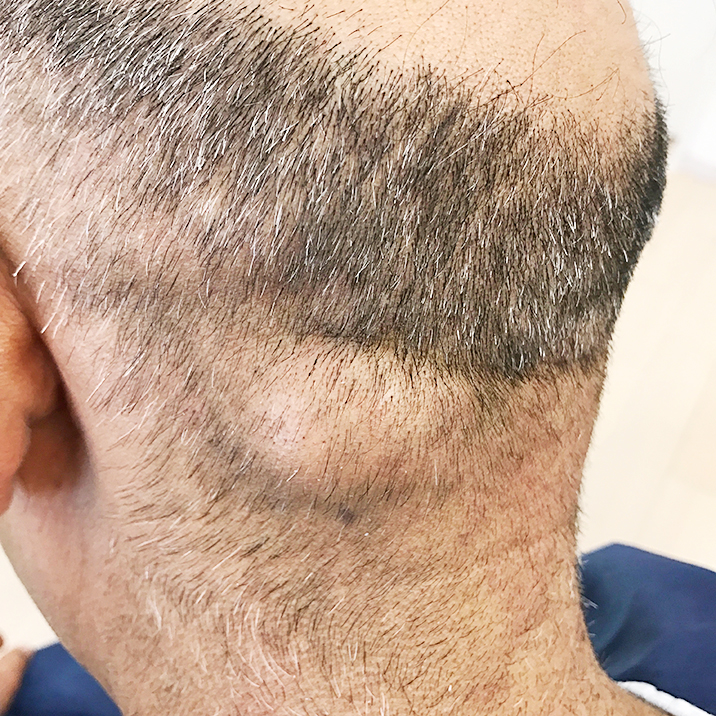


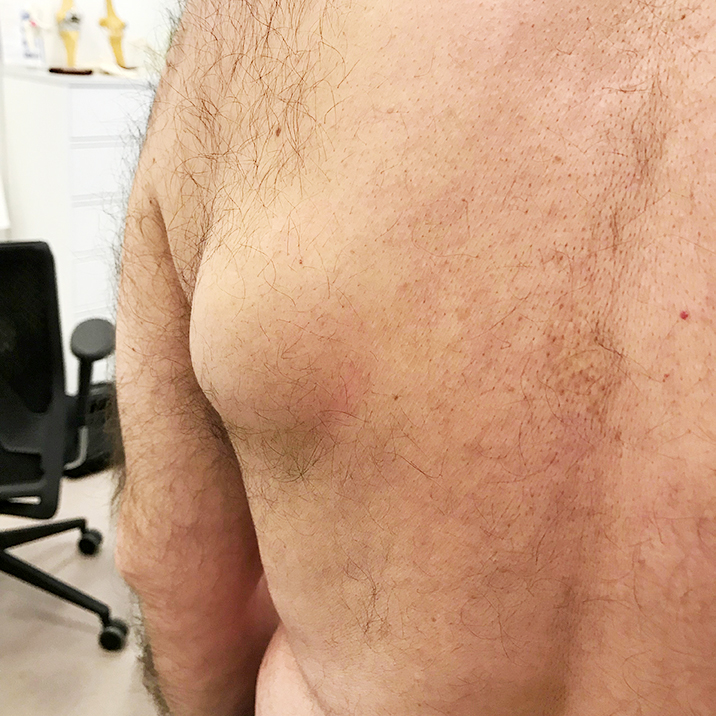
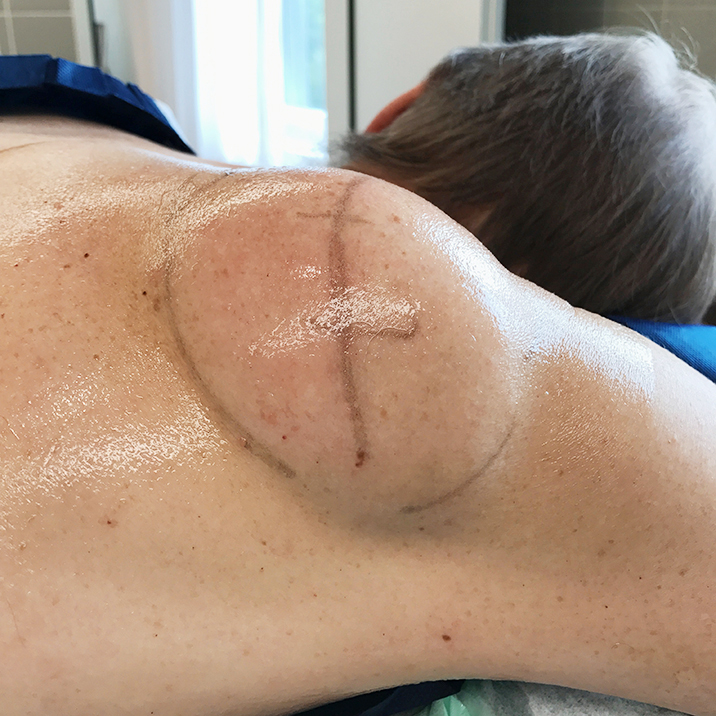


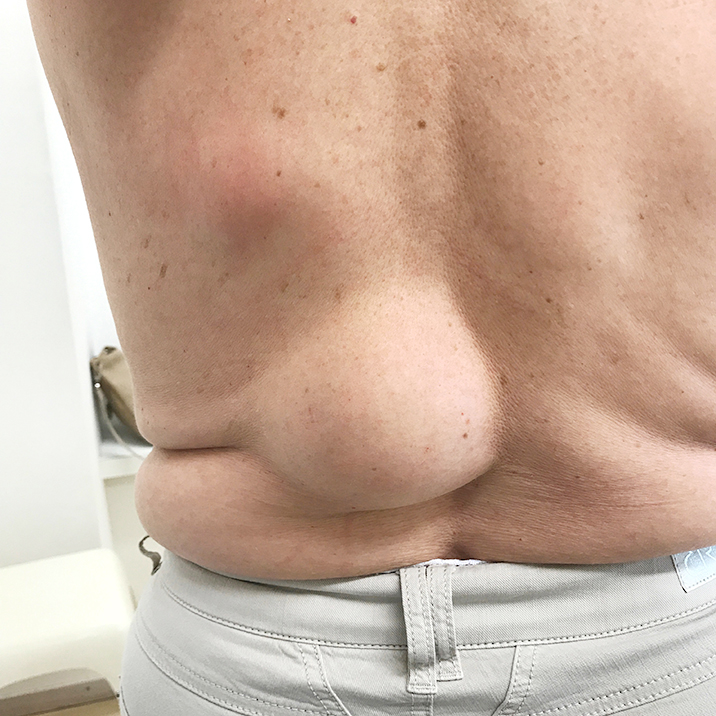


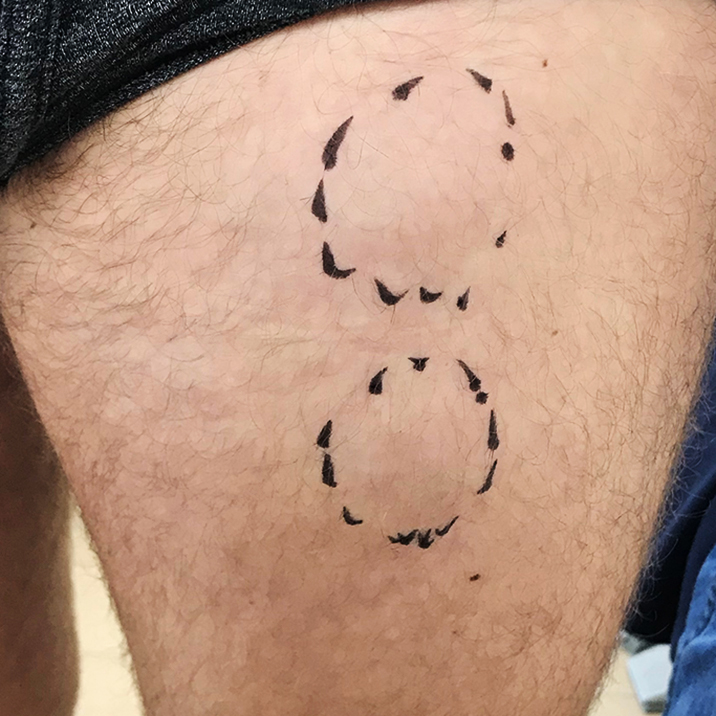
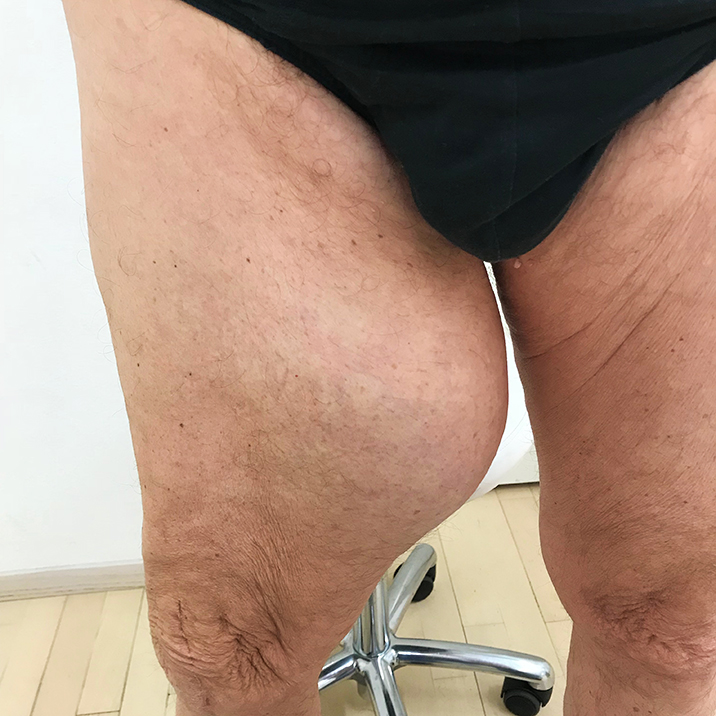


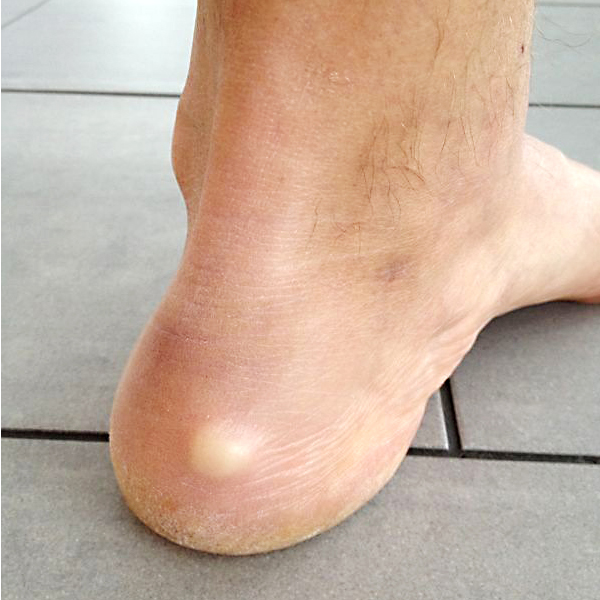
Surgical procedure
The procedure in the practice is as follows: after the welcome, consultation and changing into loose surgical clothing, you will go to our dedicated operating theatre and can lie down comfortably. After disinfection and sterile draping, the local anaesthetic is administered. This is slightly unpleasant, as it causes a brief burning sensation. The rest of the operation is painless. After the lipoma has been completely removed, haemostasis is performed. Depending on the size of the lipoma and the nature of the wound cavity, the wound is closed in layers. For very large lipomas, usually over 15 cm in diameter, a drain (tube to allow wound fluid to drain) is inserted. It is important to remove the entire lipoma. If part is left behind, the lipoma may recur. The suturing technique and suture material for skin closure are selected depending on the skin and the surgical site. After the skin sutures, the wound is covered with a shower-proof dressing.

The amount of local anaesthetic (depending on the patient’s size and weight) is the limiting factor for very large or multiple lipomas. Depending on the location of the lipomas and the patient’s wishes, 6–8 lipomas can be removed at once. If more lipomas need to be removed, the remaining ones can be removed in a subsequent session.


Examples of removed lipomas


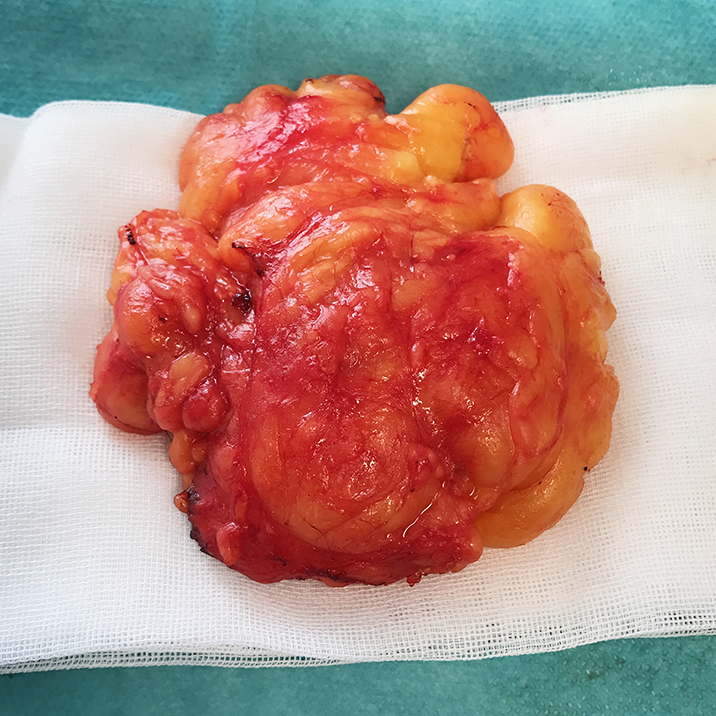


Time required, risks and aftercare
For typical sizes, removal takes approx. 45 minutes. As soon as you have changed back into your clothes and feel well, you may go home independently after receiving the medications, dressings and, if required, a certificate. If you are very tense, we can give you something to calm you before the operation. In this case, you must not drive a car or operate other vehicles afterwards.
Normally, you can resume your usual life immediately. What you should bear in mind after this operation is that even small wounds need rest to heal. You must refrain from sport, swimming and sauna visits for 14 days. If non-dissolving sutures could not be used, they must be removed after 10 to 14 days. The suture line should be kept covered with a dressing for that period. For larger wounds or physically demanding work, a certificate of incapacity for work can be issued. Likewise, if sport is interrupted, a certificate of incapacity for sport can be issued.
As mentioned, these guidelines apply to typical lipomas. For large or very large lipomas, the operation and aftercare are more involved and take longer.
Like all scars, while they are fresh they must be protected from the sun. If you wish to sunbathe shortly after the operation, you should protect the scar with a high-SPF sunscreen or with a dressing.
The surgical risks for removing most lipomas are very low. Infections occur very rarely. However, they can be treated easily with antibiotics. Scars are usually not visible or only minimally visible. If you are prone to unsightly scarring, measures are taken intraoperatively and postoperatively to prevent this. Nerve or vessel injuries practically do not occur due to experience. Rarely, with lipomas that are firmly adherent to a cutaneous nerve, temporary numbness may occur, which disappears again after a few days to several weeks.
Pain after the operation is not severe and can be well managed with the medications provided.
Costs for lipoma removal
The costs of lipoma removal at the practice are covered by basic health insurance. As many patients nowadays choose a higher deductible, it is useful to know the costs.
Depending on size and complexity, the costs for most lipomas from 0.5 cm to 5 cm are approx. CHF 300 to approx. CHF 800. For lipomas on the face, forehead and hands, slightly higher tariffs apply, approx. CHF 450 to approx. CHF 900. For large, very large or multiple lipomas, the costs are higher depending on complexity, CHF 1000.– to CHF 2000.–.
Please note that a histopathological examination of the lipoma in an external laboratory will incur additional costs of at least approx. CHF 100 to CHF 140 per submitted sample.

What I can do for you
With over 30 years of surgical experience in operating on lipomas, I can offer you optimal treatment—just as I would wish for my relatives or for myself. You are welcome to arrange an appointment for a consultation via the telephone number below. If you wish to arrange an operation date directly, we can gladly make this possible for smaller findings with a secure diagnosis and an uncomplicated location. Please mention this when registering by phone. Please state the size and location of the lipoma so that we can schedule the appropriate time for the procedure.
Appointments
You can make an appointment by calling the practice, or your family doctor can refer you to us. Please bring your health insurance card with you on your first visit.
If available, please bring medical and surgical reports with you. In our practice, we treat patients of all insurance classes.
If the operation is only possible in a hospital, you will need semi-private or private supplementary insurance. The operation will be performed at the Bethanien Clinic.
How to reach us:
Phone: 044 380 33 44
Email: tomas.rajmon@hin.ch
Consultation hours:
By appointment.
Availability by phone:
Monday to Wednesday 8:00 AM – 12:00 PM and
1:30 PM – 5:00 PM
Thursday and Friday from 8:00 AM – 12:00 PM

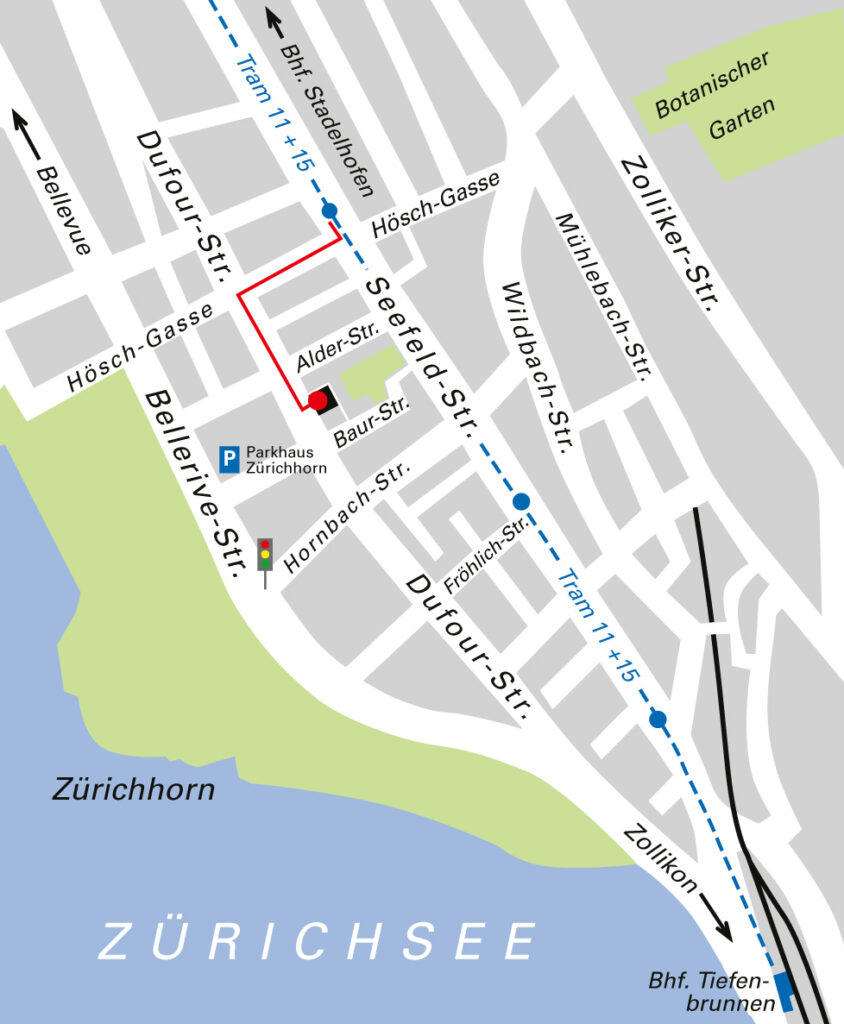
How to find us
By public transport:
Use tram numbers 11 and 15, as well as bus line 33 to the Höschgasse stop. At the post office, walk into Höschgasse towards Lake Zurich. Turn left into Dufourstrasse at the next intersection. The practice is located directly opposite the Zürichhorn parking garage.
By car:
Turn from Bellerivestrasse into Hornbachstrasse at the traffic lights. You will usually find some blue-zone parking spaces in the neighbourhood. Additional parking is usually available in the Zürichhorn car park. The practice is located directly opposite the Zürichhorn car park.